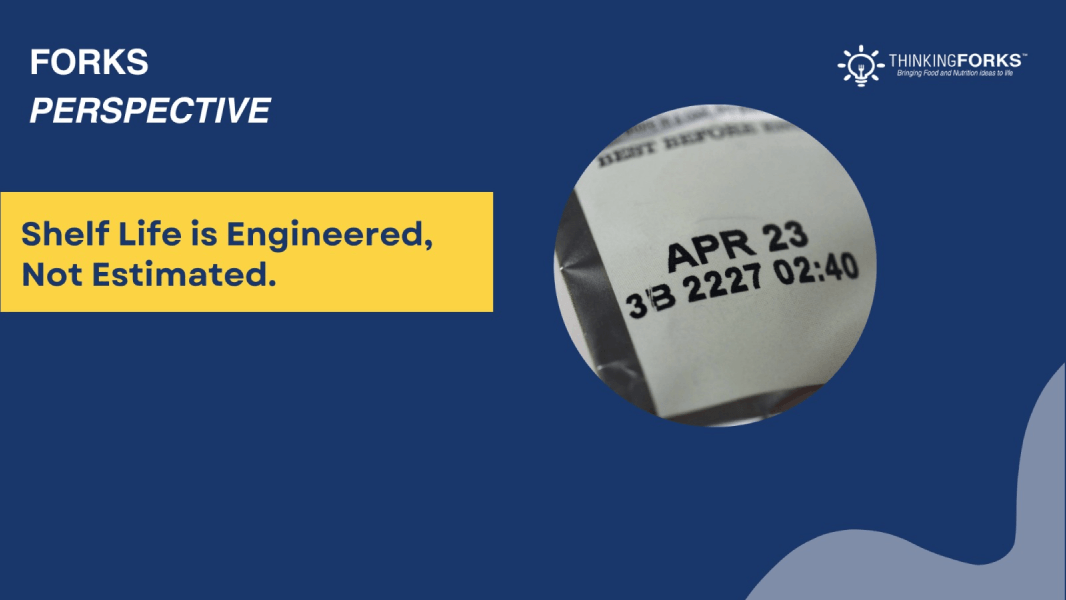
Shelf Life is Engineered, Not Estimated: Why the Best Before Date is a Design Choice
That “best before” date printed on your product packaging? It’s not a regulatory check box or guess work, its pure science design.
Most brands treat shelf life like a final label decision – a test you run at the very end of product development just to see how long the product lasts. But the smartest food and beverage brands treat shelf life like shelf-life design. It is a deliberate, scientific architecture built across every single stage of the development cycle.
Behind every successful shelf-life claim is a matrix of calculated decisions made during formulation and processing. If you want your product to perform on day 90 exactly the way it did on day one, you must design for it from the start. This is the very challenge we food consultants solve for.
In our work of Food R&D, here is how true shelf-life engineering works, and why it changes everything from the formula room to the retail shelf.
The Three Pillars of Shelf-Life Design
When a product fails on the shelf, the failure rarely stays in one lane. A change in texture can be tied to packaging, a change in flavor can be tied to processing, and microbial risk is deeply tied to formulation.
To build a truly stable product, integrated shelf-life design must be run across three distinct pillars:
1. Product (Formulation Stability)
Stability starts in the compounding bowl or mixing tank. Engineering shelf life at the product level means mastering intrinsic factors like water activity ($a_w$), pH control, moisture migration, and oxidative stability. If you are launching a dual-texture snack (like a cream-filled biscuit), you must scientifically manage moisture migration so the biscuit stays crunchy and the filling stays soft. Without this foundational chemistry, the product is compromised before it ever hits a conveyor belt.
2. Process Science (Line Integrity)
You can have a perfect benchtop prototype, but shelf-life changes when you scale up. Process science ensures line integrity through thermal validation, precise extrusion or drying parameters, and mitigating contamination risks during manufacturing. A slight variance in processing temperature or a minor drop in line consistency can completely alter a product’s degradation timeline.
3. Packaging (Barrier Performance)
Your packaging is your product’s armor against the world. Designing for shelf life requires evaluating barrier performance against oxygen and moisture, optimizing Modified Atmosphere Packaging (MAP) or gas retention, and ensuring absolute seal integrity. Your packaging must be engineered to withstand the ambient stresses of storage, transportation, and fluctuating distribution environments.
Decoding Your Product’s “Degradation Fingerprint”
A biscuit doesn’t age like a beverage. A cracker doesn’t degrade like a sauce.
Every food matrix has a unique degradation fingerprint. For a high-fat snack, the primary threat might be lipid oxidation (rancidity). For a powdered drink mix, it’s caking and moisture absorption. For a fresh baked good, it’s mold growth.
Because every product degrades differently, shelf-life testing cannot be a one-size-fits-all checklist. The study must be custom-built around the specific vulnerabilities of your product. By identifying this fingerprint early, you close the gap between your shelf-life expectations and actual retail performance before it becomes a costly commercial problem.
The Blueprint: How We Get There
Bridging the gap between a benchtop concept and a stable commercial product requires a systematic, data-driven approach:
- Product Integrity Mapping: Analyzing the formulation to find weak points and chemical vulnerabilities before the market does.
- Comprehensive Stability Studies: Running simultaneous microbial, sensory, and physio-chemical testing to see exactly how flavor, texture, safety, and color evolve over time.
- Correlation Analysis: Aligning the variables of product, process, and packaging to ensure they work in harmony rather than against each other.
- Stress Evaluation: Simulating real-world distribution and storage conditions – such as temperature spikes and humidity fluctuations – to test the product’s resilience under pressure.
The goal? Root-cause identification before commercial launch. If a product is going to fail, you want it to fail in the lab, where it can be fixed – not on a retail shelf.
The Commercial Power of Shelf-Life Design
When shelf-life design starts at day one in the food product development process, every downstream business metric gets smarter. Investing in the science of stability yields massive commercial advantages:
- Accelerated Time-to-Market: By understanding the science of your product from the start, you navigate a lower-risk path from lab to shelf, avoiding late-stage reformulations.
- Data-Driven Decision Making: No more guesswork. You gain the exact data needed to make optimized formulation and cost-effective packaging choices.
- Reduced Consumer Complaints: Quality is verified and assured long before the product ever reaches a consumer’s hands, protecting your brand equity.
- Consistent Product Quality: You ensure that every single batch delivers the exact same sensory experience throughout its entire shelf life.
- Substantiated Product Claims: Your “Best Before” dates and nutritional claims become scientifically defensible, transparent, and completely audit-ready.
Design for Longevity
Shelf life isn’t an afterthought, and it isn’t an estimation. It is a critical element of product architecture. By designing with water activity, barrier integrity, and microbial stability in mind from the very first iteration, you build a food & beverage product that survives the supply chain and wins the consumer.
Don’t just hope your product lasts – engineer it to endure.