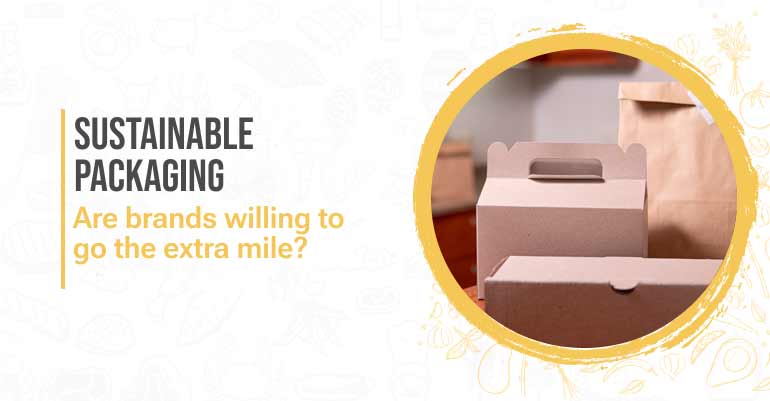
The world has moved on from replacing plastic and eliminating single-use plastics. Eco-conscious consumers hold brands accountable. ‘Better for me, better for the planet’ is the new mandate — making sustainable packaging a necessity and not a choice.
 Just because your brand has the right product, demographic, and target segments don’t mean consumers will adopt it. They want to feel good about their purchases — nearly 44% of shoppers won’t buy a product if the packaging is considered environmentally harmful.
If you are looking to use sustainable packaging as a way to reduce your carbon footprint and carbon emissions, a switch to biodegradable plastics and bioplastics may not yield desired results. Why? Because sustainability is not a one-size-fits-all solution. It is time to reimagine sustainability through new material research and design innovation relevant to your product, target consumers, and region.
What you need to consider
- Safety and health checks throughout its life cycle
- Cost and performance to meet market demands
- Renewable material source
- Shelf life
- Clean production technologies
- Flexibility in design and functionality
- Reusable and recyclable without carbon emissions
Testing is critical to determine the efficiency of your new alternative. Before scaling-up production, quick prototyping and trials allow you to determine what works and what doesn’t. For instance, Colman’s in the UK and Ireland has switched to recyclable paper-based packaging for their sausage range. Similarly, Coca-Cola debuted its first-ever paper bottle prototype in Hungary through a small-scale online trial. Consumer feedback and commercial viability point to the direction of how to optimize it further.
Major corporations and start-ups are aggressively disrupting the market in the race to become sustainable and win over consumers. It is not a good idea to pass the cost onto the customer. Go beyond basics and strategize to resolve carbon footprint, supply chain complexity, and increasing input costs that support product differentiation.
Several brands have been known to greening up their foods and beverages by just adding plant-based ingredients to products like meats and dairy. However, this can lead to further confusion and paranoia on the part of the consumer. Prof Joanne Slavin, from the Department of Food and Nutrition, University of Minnesota explains that intake of nutrients like fiber, potassium, calcium, and Vitamin D can lead to a decline of clean label adherence as the ingredients may be listed in the form of chemical-sounding jargon.
At Thinking Forks, we help you with

- Creation of sustainability roadmap and strategy
- Development of sustainable packaging materials
- Rapid prototyping, shelf life testing, commercialization
- Documentation and coordination with PRO & PCBs
We enabled ‘Tasty Tales’, a ready-to-cook gourmet brand with its packaging design. Our rapid prototyping techniques and scientific expertise helped them move from a high MOQ laminated pouch to a low MOQ board-based solution — delivering shelf life and 46% lower plastic consumption.
Our team helps you meet customer expectations and regulatory requirements — efficiently and cost-effectively. Over the years, we have partnered with major Fortune 500 companies and emerging D2C start-ups with new packaging designs, 3D prototyping, mould management, packaging material expertise, and artwork development.
Write to us at info@thinkingforks to know more.