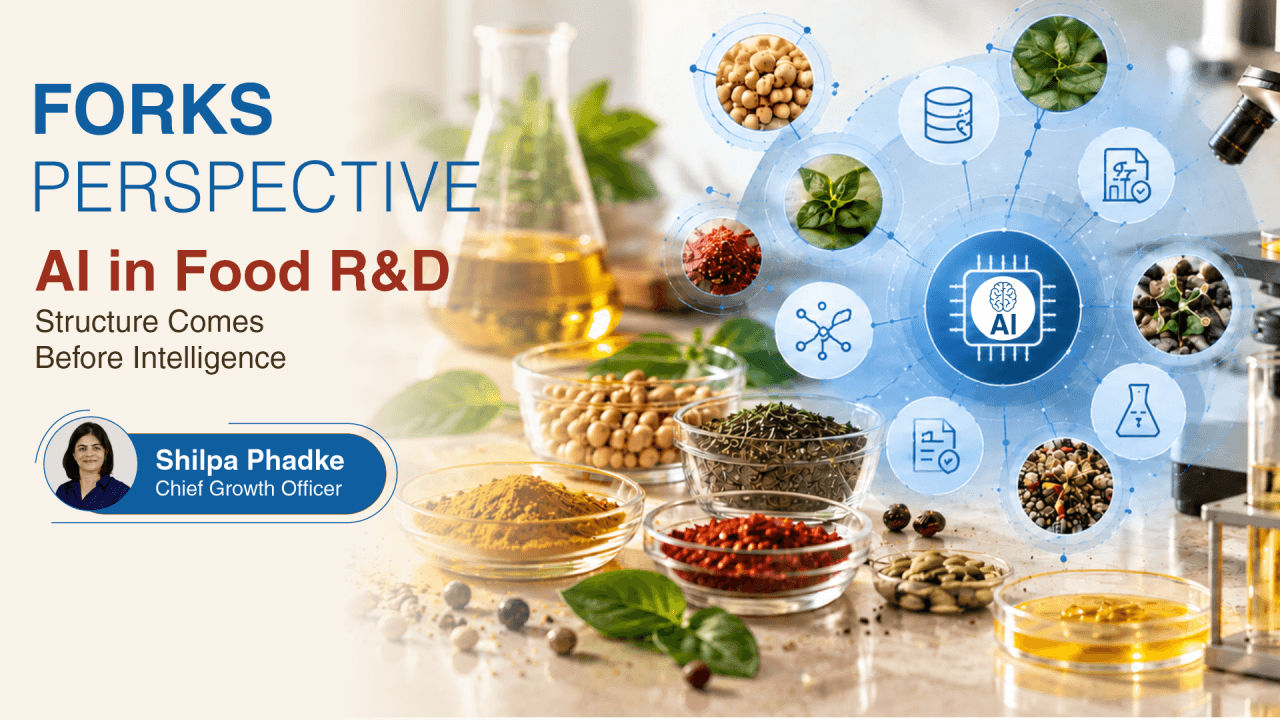
AI in Food R&D: Structure Comes Before Intelligence
Every few weeks we read that AI will reinvent R&D. McKinsey suggests AI could double the pace of R&D. PwC talks about product development cycles shrinking by up to half. Yet a 2025 BCG survey found that only around 5% of companies get measurable value from their AI initiatives, while roughly 60% report minimal results.
So what separates the 5% from everyone else, and what does it mean for food R&D?
Most of these headline numbers come from pharma, automotive and engineering, where R&D programmes run for years and budgets run into billions. Food plays by different rules. F&B Development cycles are measured in months, success is decided on the tongue rather than in a simulation, margins are thin, and the same product may need to satisfy regulators in India, the GCC, the EU and the US. That changes where AI helps most, and what it needs in order to work. It also means the payoff shows up quickly: a few weeks saved on a reformulation can decide whether a product makes the next retail listing.
Let’s first see what AI is already bringing to food R&D
Here is our first hand experience of using AI as a full stack food R&D consulting.
Fewer, smarter trials. Past experiments can predict which formulations are worth making, so reduction in no of bench trials.
Faster reformulation. In case of supply chain issues, price increase, AI can help in finding substitutes that fit cost, nutrition and regulatory limits.
Multi-market readiness. A formulation can be checked against different regulatory frameworks.
But we all know that AI is only as good as what it learns from
Food R&D is a harder problem than it looks. AI can handle that complexity, but only if the underlying data is structured, connected and lab validated. The accuracy and usefulness of AI in food depend far less on the algorithm than on the foundation beneath it.
Every product balances taste, texture, shelf life, processing behaviour, nutrition, regulation and cost at the same time, and changing one ingredient moves five other things. That is why lab validation matters so much. AI can shortlist the three formulations most likely to succeed out of fifty, but it cannot taste them. Mouthfeel, flavour release and stability across shelf life still have to be proven on the bench, and every trial result that is captured properly makes the next prediction sharper. In food, AI and the lab don’t compete; they feed each other.
This is why Thinking Forks has created and uses the workflow platform that now sits at the centre of how Thinking Forks runs product development. It brings together:
an ingredients database with live costing, so the commercial picture is visible from the first formulation rather than after the fourth trial
a guided Design of Experiments (DoE) workflow, so trials are planned to test several variables together instead of one at a time
Live nutrition calculator & regulatory flags, so label, claim and compliance implications show up while the formula is still being built
This has helped us in expanding our data layer and become a body of R&D knowledge instead of disappearing into folders. That is the layer that makes use of AI into something that genuinely shortens the path from brief to shelf.
Three questions to ask about your own R&D data
Before investing in AI tools, it’s worth checking how ready your foundation is. A few simple questions tell you a lot:
Can you find what you learnt two years ago? If the results of an old trial, and the reasons a formulation failed, can’t be retrieved in minutes, an AI tool won’t find them either.
Do your costs move when the market does? Formulation costs kept in static spreadsheets go out of date the moment an ingredient price changes, and so does any recommendation built on them.
Can you check one formula against several markets at once? If regulatory review happens at the end, by hand, every new market means rework.
If the honest answer to any of these is no, that is where the real insight is and it usually comes before any algorithm. Getting these basics right also means every new project starts from what your team already knows, not from a fresh spreadsheet per project.
We believe that the food companies that win with AI won’t necessarily have the most sophisticated models. They’ll be the ones that organised their R&D knowledge first.
If you’re thinking about how your product development data could work harder, I would love to compare notes. Whether you are looking to digitise formulation workflows, structuring your ingredient and regulatory data, or working out where AI realistically fits into your NPD process, reach out to me at Thinking Forks.
Further reading: AI Research and Development: https://www.foodnavigator.com/Article/2025/06/19/how-ai-is-helping-the-food-industry-protect-food-security/