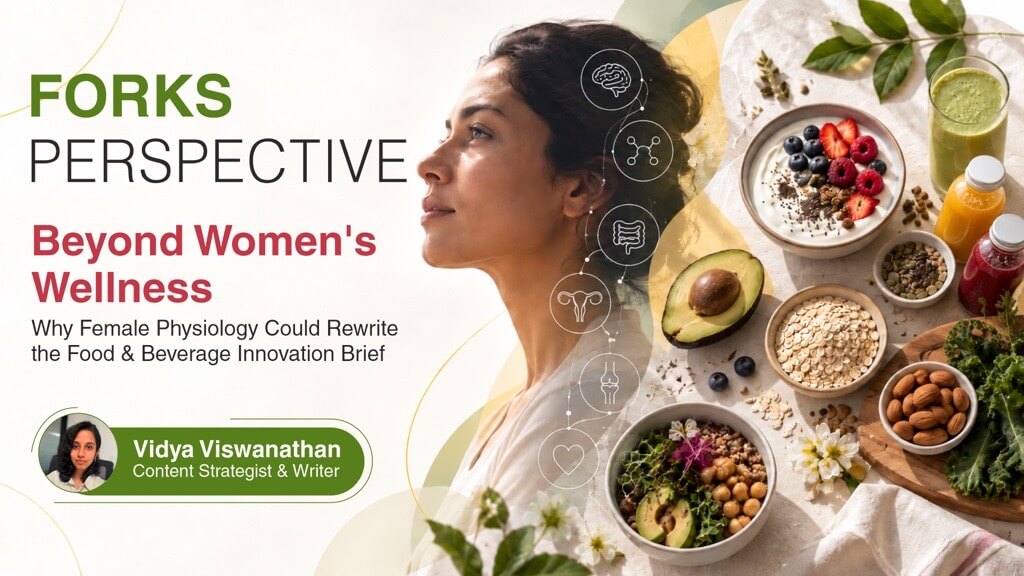
Women’s wellness is now taking center stage as a core priority, driving meaningful innovation and holistic design from the very start. We see growing consumer interest in more targeted, outcome-led nutrition that fits into their daily routine, rather than generic “wellness.”
- Global functional food & beverage market is valued at US$437.6 billion in 2026 and projected to reach US$983.2 billion by 2034, growing at a 10.65% CAGR.
- Women’s wellness is a US$312B opportunity in 2026, projected to reach US$549B by 2033.
- Functional food & beverages accounted for 57.4% of women’s wellness products in 2025.
But, the brief is no longer “make something for women.”
It’s “understand what female physiology actually needs, and build a system around it.”
The Problem: “Women” Is Too Broad a Brief
Women’s wellness as “one of the most dynamic and underserved segments” in functional food precisely because it collapsed into one demographic for so long.
- A woman navigating menstrual symptoms has a different physiological context from someone experiencing perimenopause.
- A pregnant woman has different nutritional considerations from an active woman focused on performance.
- A postmenopausal woman thinking about muscle, bone and metabolic health is operating within another biological context altogether.
That means asking at the beginning of food R&D:
- What physiological need are we addressing?
- At what point in a woman’s life or day, does it become relevant?
- Which nutrients and food matrices make biological sense?
- Can the solution become part of an everyday eating or drinking occasion?
- What evidence supports the formulation and the claims?
This moves women’s health from a marketing label to an innovation architecture.
From Symptoms to Systems: Formulating Beyond the Supplement Aisle
The opportunity isn’t about inserting supplement-aisle ingredients into food. It’s about making food itself the delivery system for physiological support.
- Imagine a protein-rich everyday food designed around maintaining muscle during healthy ageing.
- A fibre-forward breakfast format positioned around digestive wellbeing.
- A beverage designed for a specific daily need state rather than looking like a liquid supplement.
- Or a familiar food that combines nutrients consumers increasingly seek within one convenient occasion.
Current research highlights consumers’ growing interest in specific health benefits from everyday foods. For food scientists like us, this creates a more sophisticated formulation brief.
That brings formulation science – bioavailability, dosage, matrix effects, stability, sensory masking and nutrient interactions into the centre of women’s health innovation.
- The Cycle, a ready-to-drink startup, built entirely around phase-specific botanical blends – separate SKUs for pre-period, period, perimenopause, and menopause, delivered as a beverage rather than a pill.
- Bish Bar, launched in 2026, is a protein bar designed around women’s hormonal and menstrual health, combining plant protein, prebiotic fibre, micronutrients and adaptogens in an everyday snack format.
From Life Stage to Life Moment: Where Personalisation Gets Specific
Life-stage nutrition is only the starting point.
Pregnancy, menopause, adolescence and postmenopause provide useful frameworks, yet they do not fully capture how people experience health on a daily basis.
The next opportunity is life-moment personalisation.
- Think beyond: “Nutrition for women over 40.”
- Instead: “Nutrition for the physiological moment this consumer is experiencing today.”
That could mean products designed around energy, digestive comfort, satiety, sleep, cognitive performance or muscle maintenance, needs that may become more or less relevant depending on the individual’s circumstances.
The Cycle, for example, translates cycle-specific support into a ready-to-drink format, with separate PMS and Period Relief formulations combining Omega-7 with cold-brewed botanicals.
2026 women’s-health research points toward this outcome-led behaviour. Consumers may experience hormone-related changes without necessarily shopping under a “hormonal health” proposition.
They could instead seek help with tangible outcomes such as sleep, stress, energy, cognition or weight management.
- We Are Regular translates female-focused gut health into a daily powder format, combining magnesium citrate with botanicals and other nutrients for bowel regularity and bloating support.
Menopause Is Bigger Than Menopause
Menopause is moving beyond symptom relief into a broader healthy-ageing opportunity, bringing muscle, bone, metabolic, cardiovascular, sleep and cognitive health into the innovation brief. The menopause-targeted functional food and beverage market reflects this opportunity, valued at US$3.2B in 2025 and projected to reach US$7.7B by 2036.
- Nestlé Health Science is broadening menopause nutrition beyond symptom management, connecting it to longer-term priorities such as bone, sleep and metabolic health, while its wider healthy-ageing strategy brings strength, energy and cognitive health into everyday nutrition.
- Mena has built a menopause-focused food range spanning protein bars, breakfast cereals, porridge pots, bread and snacks, incorporating plant oestrogens and botanicals into familiar everyday formats.
The Emerging White Space: Where Gut, Hormones and Metabolism Meet
The most interesting innovation platform emerging isn’t a single ingredient. It’s the biological connections between systems.
The gut–hormone and gut–ovary axes are emerging areas of research that could increasingly inform formulation thinking.
Growing evidence points to the gut microbiome’s involvement in hormone metabolism, immune and metabolic signalling, and pathways relevant to conditions such as PCOS.
- ADM’s postbiotic L. gasseri CP2305 illustrates where strain-specific microbiome science is moving. Clinical research has investigated the strain in both premenstrual and menopausal contexts, showing how microbiome interventions are being studied across different female physiological life stages.
The Future of Women’s Health Is Not a Category. It’s a Design Principle.
Female physiology is becoming the lens for food and beverage innovation. For Food R&D teams like ours, that means designing differently.
- Demographics → Biology
- Life stages → Life moments
- Single benefits → Connected systems
- Supplement-style ingredients → Food-first delivery
- Female branding → Female-informed formulation
- Marketing differently → Designing differently.
The advantage will belong to those who translate increasingly sophisticated knowledge of female physiology into foods women actually want to eat every day. Because the future of women’s health will be built into breakfast, beverages, snacks, dairy, active nutrition, everyday staples and the occasions in between.
Ready to rethink the women’s health innovation brief in food product formulation? Reach out to us at www.thinkingforks.com and explore more about our new product development process approach at https://thinkingforks.com/new-food-product-development/.